
Home › Orthodontics › Conditions We Treat › Underbite
Conditions · Children, teens & adults
Underbite in Children and Adults: Causes and Treatment Options
An underbite is when the lower front teeth sit in front of the upper front teeth as you bite. It can come from tooth position or from how the jaws grow. At Yonsei Baro near Isu Station, Dr. Sally Chaekyung Lee checks underbites early, because some can be guided during growth while others need later planning.
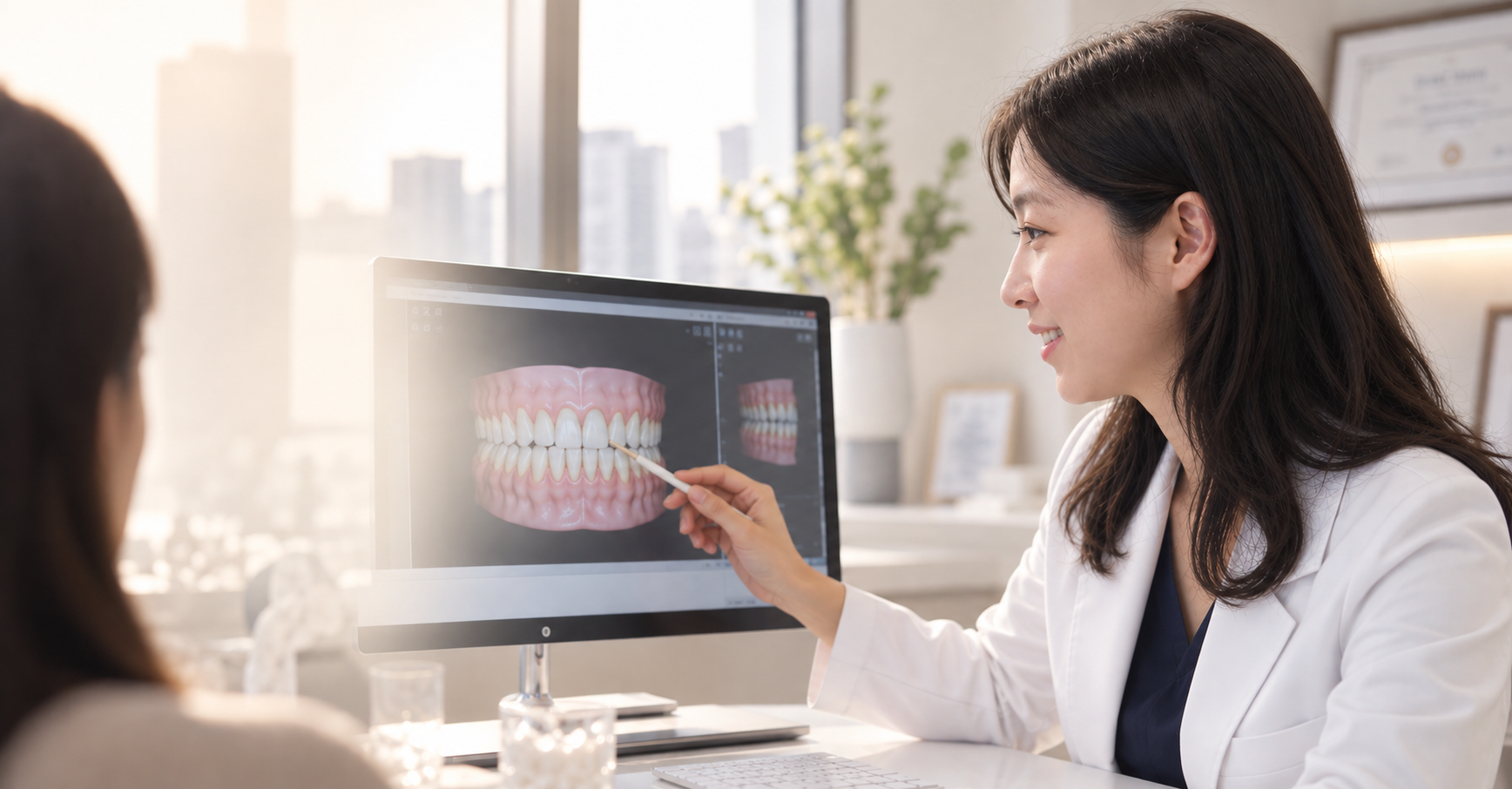
Underbite at a glance
| Question | In brief |
|---|---|
| What it is | The lower front teeth bite in front of the upper front teeth; orthodontists call the jaw pattern Class III |
| Common causes | Inherited jaw growth (a large or forward lower jaw, a small upper jaw, or both), front teeth tipped the wrong way, or the jaw sliding forward to bite |
| Usually noticed | Often visible in baby or early mixed teeth; a family history is common |
| How it’s assessed | Check for a forward jaw slide, X-rays or 3D CT, RAY Face scan of the profile, growth analysis and family history |
| Treatment options | Early correction of tooth position or upper-jaw growth guidance in children; braces or aligners; combined orthodontic and surgical treatment for some skeletal cases after growth |
| Typical approach: children | Early evaluation; treat dental and functional underbites promptly; monitor skeletal underbites through growth |
| Typical approach: adults | Braces or aligners when the jaw difference is mild; combined treatment with an oral & maxillofacial surgeon when it is significant |
What causes an underbite?
Underbites fall into broad groups, and telling them apart is the most important step in planning:
- Dental underbite: the jaws are reasonably balanced, but the upper front teeth are tipped back or the lower ones forward
- Functional underbite: the front teeth meet edge to edge, so the lower jaw slides forward to let the back teeth close. Sometimes called a pseudo-underbite
- Skeletal underbite: the lower jaw is large or forward, the upper jaw is small or set back, or both. This is often inherited
Many underbites are a mix, and a crossbite of the side teeth often comes with them. See crossbite .
Does my child need treatment now?
An underbite is one of the bite problems where an early orthodontic check is especially useful. Dental and functional underbites can often be corrected in younger children with a relatively short phase of treatment, which can help the jaws develop in a better relationship and protect the front teeth from wear.
Skeletal underbites need more caution. Growth guidance, such as appliances that widen the upper jaw or encourage it forward, can help some children, but lower-jaw growth tends to continue into the late teens and the underbite may return. Dr. Lee will explain honestly what early treatment can and can’t achieve. See early orthodontic treatment and growth guidance .
Can an underbite be fixed without surgery?
Sometimes. Dental and functional underbites, and mild skeletal ones, can often be treated with braces or aligners by adjusting the angles of the front teeth. This is called camouflage treatment, and it works within the limits of the bone around the roots and the face.
When the jaw difference is significant, moving teeth alone may not give a stable bite or a balanced profile. For these patients the usual approach is combined orthodontic and surgical treatment once growth has finished: braces or aligners prepare the teeth, an oral and maxillofacial surgeon repositions the jaw, and orthodontic treatment then refines the bite. Whether you need this can only be decided after a full examination.
Dr. Lee’s research on surgical-orthodontic treatment
Dr. Lee has studied what happens after jaw surgery, an area that matters when planning these cases. She received an Excellent Poster Award at the 53rd Korean Association of Orthodontists (KAO) congress for research on post-surgical changes in skeletal Class III with facial asymmetry, and a KAO Commendation in 2025 for surgical-orthodontic stability research. She is also an author of a 2024 Applied Sciences paper on post-surgical stability after jaw surgery for Class II bites. See research and awards .
How Dr. Lee assesses an underbite
She first checks whether the jaw slides forward on closing. A RAY Quantum 5D CT scan shows the size and position of both jaws, roots and bone, and a RAY Face scan records the profile and any facial asymmetry. For children, growth analysis estimates how much growth remains. You can see consented cases on our before-and-after page ; results vary.
Underbite FAQs
At what age should a child’s underbite be checked?
As soon as you notice it. Many orthodontists suggest a check by about age 7, but an underbite is a reason to come earlier, because dental and functional underbites are often simpler to correct while children are young. If the underbite is skeletal, an early visit also lets Dr. Lee monitor growth and plan the timing.
Can an underbite come back after early treatment?
It can, particularly when the cause is skeletal. The lower jaw tends to keep growing into the late teens, and growth in some people outpaces the correction made in childhood. That is why children treated early for a skeletal underbite are monitored through growth, and some still need further treatment later.
Who performs jaw surgery for an underbite?
Jaw surgery is performed by an oral and maxillofacial surgeon, usually in a hospital. Dr. Lee plans and carries out the orthodontic stages before and after surgery and coordinates the plan with the surgeon. Surgery is usually considered once growth is complete, and the decision is always yours.
Is an underbite inherited?
Skeletal underbites often run in families, so it helps to mention if a parent, grandparent or sibling has one. A family history does not mean a child will definitely develop a severe underbite, but it is a good reason for an early check and regular monitoring through growth.
Can clear aligners correct an underbite?
Aligners can correct some dental and mild skeletal underbites in teens and adults, often combined with elastics worn between the upper and lower teeth. Children may suit aligners designed for growing patients, such as Invisalign First. Significant skeletal underbites usually need braces, growth guidance or combined surgical treatment instead.
Medically reviewed by Dr. Sally Chaekyung Lee, DDS, PhD
Board-certified orthodontist (Korea Ministry of Health and Welfare) · Adjunct Professor of Orthodontics, Yonsei University · Last updated October 2026
This page is general information, not a diagnosis. Treatment results and duration vary from person to person. Orthodontic treatment can cause temporary discomfort and, in some cases, root shortening, gum recession or tooth decay if oral hygiene is poor; teeth can relapse if retainers are not worn as instructed.
Worried about an underbite?
Book an examination for your child or yourself. Dr. Lee will explain in English whether it is dental, functional or skeletal, and what that means for treatment. Isu Station Exit 2 · Open until 9 PM Mon & Thu · Saturdays 9 AM–2 PM.