
Home › Orthodontics › Early Treatment (Phase 1)
Kids’ orthodontics · Ages 7–10
Early Orthodontic Treatment (Phase 1) for Children in Seoul
Early orthodontic treatment, often called phase 1, corrects specific bite or jaw problems while a child is still growing, usually between about 7 and 10. Many children need only monitoring. At Yonsei Baro, near Isu Station, Dr. Sally Chaekyung Lee explains in English whether early treatment would help your child or whether waiting is wiser.
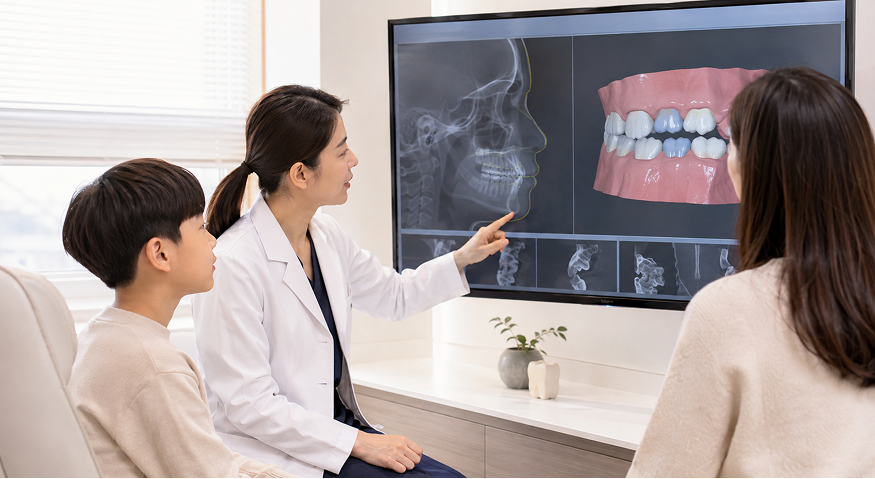
Early orthodontic treatment at a glance
| Question | At Yonsei Baro |
|---|---|
| First check | By age 7, as recommended by the American Association of Orthodontists |
| Typical phase 1 ages | About 7–10, while baby and adult teeth are mixed |
| Aim | Correct specific problems early and guide growth, not to finish the whole job |
| Second phase | Often still needed once most adult teeth are in |
| When to wait | Mild crowding or spacing, and problems easier to treat once adult teeth have erupted |
| Treated by | Dr. Sally Chaekyung Lee, board-certified orthodontist, in English |
Why is an orthodontic check recommended by age 7?
The American Association of Orthodontists (AAO) recommends that children have their first orthodontic check no later than age 7. By then, the first adult molars and front teeth have usually come in, so an orthodontist can see how the upper and lower jaws are developing, whether there is likely to be enough space, and whether a habit is affecting the bite.
A check is not the same as treatment. For most children, the visit confirms that development is on track and sets a time to look again. Our guide when should my child see an orthodontist? lists the signs worth booking for.
Which problems are worth treating early?
Early treatment is usually recommended when waiting would allow a problem to become harder to correct, or when it is causing harm now:
- Crossbites , especially when the lower jaw shifts to one side to bite together
- A developing underbite , where lower front teeth sit in front of the uppers
- Upper front teeth that stick out far enough to be at risk of injury
- Severe crowding, or baby teeth lost early so that space for adult teeth is closing
- Thumb sucking, tongue thrust or mouth breathing that is changing the bite
Depending on the problem, phase 1 may use an expander, a habit or functional appliance , a space maintainer , a few braces on the front teeth, or clear aligners designed for children.
How does two-phase treatment work?
Phase 1: early, focused treatment
A shorter course of treatment aimed at one or two specific problems while the jaws are growing. Growth guidance is often part of this phase.
A resting period
Once phase 1 is complete, the remaining adult teeth come in. Your child may wear a retainer, and Dr. Lee checks progress periodically.
Phase 2: comprehensive treatment
When most adult teeth have erupted, usually in the early teens, braces or aligners align all the teeth and refine the bite. See orthodontics for teenagers .
An honest note about phase 2
Phase 1 does not always remove the need for a second phase. Many children who have early treatment still need braces or aligners later. The aim of phase 1 is to correct a problem that would otherwise worsen, or to make later treatment simpler, not to replace it.
For some problems, such as many cases of protruding upper front teeth, research suggests starting early does not always shorten total treatment time, although it can lower the risk of injury to those teeth. Dr. Lee will explain what early treatment can realistically achieve for your child, and what is likely to follow.
Pros and cons of early treatment
Possible benefits
- Uses growth to improve jaw relationships while it is still possible
- Corrects a jaw shift before it becomes established
- Protects protruding front teeth from injury
- Can hold or create space for adult teeth
Things to weigh up
- Two phases can mean more total time in appliances
- It relies on your child’s cooperation at a young age
- A second phase may still be needed
- Some problems are treated just as well later
When is waiting the better choice?
Many issues in young children are better watched than treated. Mild crowding often changes as adult teeth erupt, and a gap between the upper front teeth frequently narrows as the canines come in. Problems that depend on the final position of adult teeth are usually easier to treat in one comprehensive phase later.
Dr. Lee, formerly director of pediatric and adolescent orthodontics at CDC Children’s Dental Clinic, will tell you plainly when waiting is the right step and when to come back. If your family may leave Korea, she can also plan around your move.
Early treatment FAQs
What happens at an age-7 orthodontic check?
Dr. Lee looks at your child’s teeth, bite, jaw growth, breathing and swallowing habits, and how the adult teeth are coming in. X-rays or other records are taken when they will help with a decision. You then hear, in English, whether to monitor, treat now or simply return in a year or so, and why.
If my child has phase 1, will they still need braces later?
Possibly. Many children need a second, comprehensive phase once their adult teeth are in, even after successful early treatment. Phase 1 targets specific problems while growth can help; phase 2 aligns all the adult teeth and refines the bite. Dr. Lee will tell you at the start how likely a second phase is for your child.
How long does phase 1 treatment usually last?
It depends on the problem. Correcting a crossbite with an expander, for example, is often a matter of months, while guiding jaw growth can take longer. Many phase 1 treatments are measured in months rather than years. You receive an estimated timeline after the examination.
Is early treatment worthwhile if we are leaving Korea soon?
Sometimes. A focused problem such as a crossbite can often be corrected within a typical posting, while longer plans may be better started after you settle. Share your expected dates and Dr. Lee will suggest what can sensibly be done here, then provide English records for your next orthodontist.
Can early treatment prevent the need for jaw surgery?
For some developing underbites or narrow upper jaws, early treatment can improve the jaw relationship. It cannot always prevent surgery later, particularly when the lower jaw keeps growing strongly in the teenage years. Dr. Lee explains realistic expectations and continues to monitor growth after phase 1.
Medically reviewed by Dr. Sally Chaekyung Lee, DDS, PhD
Board-certified orthodontist (Korea Ministry of Health and Welfare) · Adjunct Professor of Orthodontics, Yonsei University · Last updated October 2026
This page is general information, not a diagnosis. Treatment results and duration vary from person to person. Orthodontic treatment can cause temporary discomfort and, in some cases, root shortening, gum recession or tooth decay if oral hygiene is poor; teeth can relapse if retainers are not worn as instructed.
Book an early orthodontic check
Tell us your child’s age and what you have noticed. Dr. Lee will examine your child and explain, in English, whether to wait or treat. Isu Station Exit 2 · Open until 9 PM Mon & Thu · Saturdays 9 AM–2 PM.