
Home › Orthodontics › Conditions We Treat
Orthodontics · Children, teens & adults
Bite Problems and Orthodontic Conditions We Treat
At Yonsei Baro Orthodontics near Isu Station in Seoul, Dr. Sally Chaekyung Lee, a board-certified orthodontist, diagnoses and treats crowding, gaps, deep bites, protruding teeth, underbites, crossbites, open bites, impacted canines, jaw asymmetry and habit-related bite problems in children, teens and adults. Each guide below explains causes, timing and options in plain English.
How do I know if a bite problem needs attention?
Some bite problems are easy to see in the mirror; others are easy to miss, because the teeth look fairly straight but meet in the wrong way. Signs worth having checked include:
- Upper front teeth that completely cover the lower teeth, or front teeth that don’t touch at all
- Lower front teeth that sit in front of the upper teeth
- A jaw that slides to one side as the teeth close
- Adult teeth coming in out of line, or baby teeth lost much earlier or later than usual
- Mouth breathing, a thumb-sucking habit beyond early childhood, or a tongue that pushes between the teeth
The American Association of Orthodontists recommends a first orthodontic check-up by about age 7. Most children seen at that age don’t need treatment yet; the visit is about spotting problems that are easier to guide while a child is still growing. Our guide on when your child should see an orthodontist explains what we look for.
Teeth, jaws and face: why diagnosis comes first
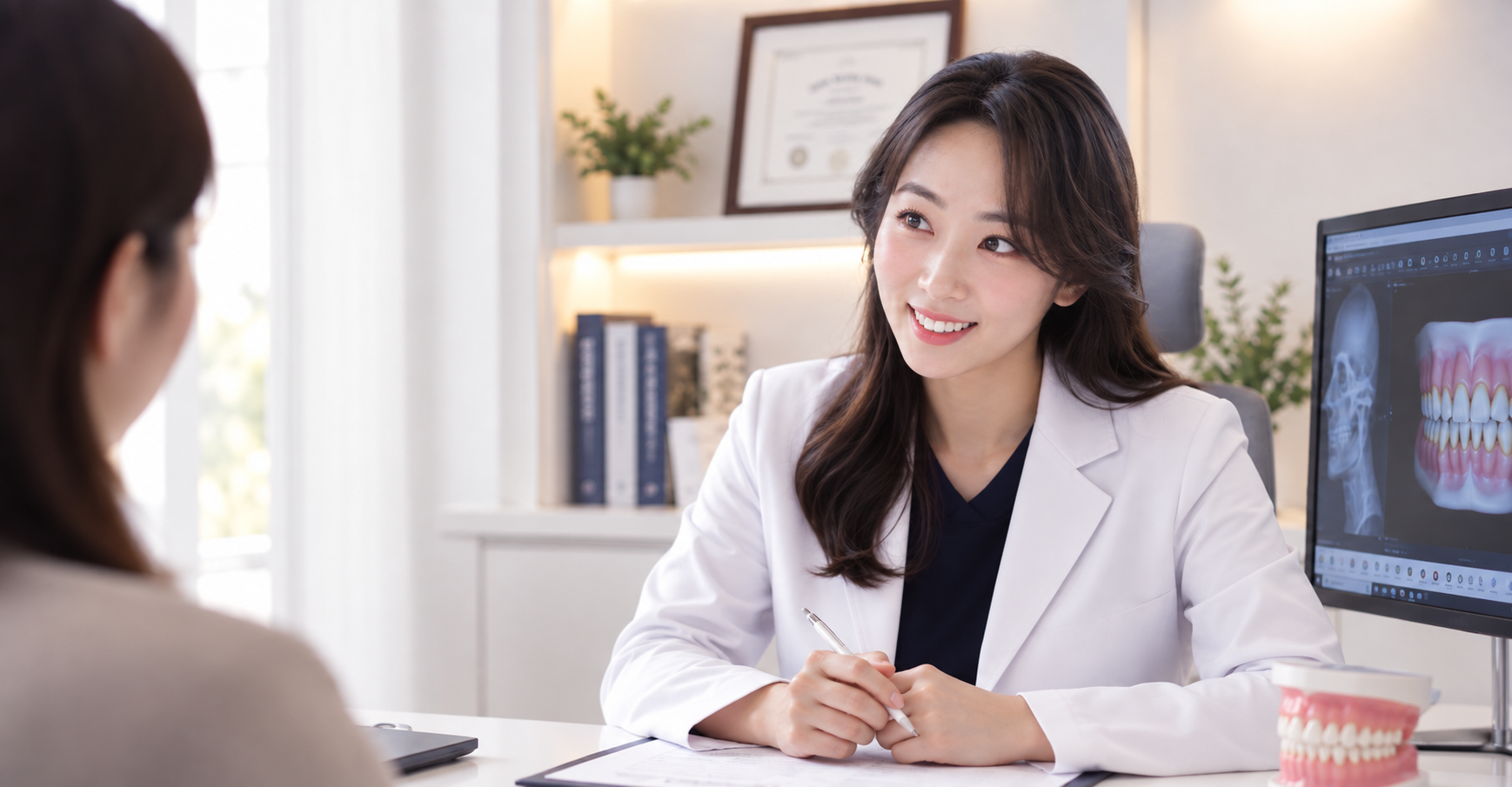
Problems that look alike can need very different treatment: an underbite, for example, may come from tooth position or from jaw growth. Dr. Lee examines the teeth, bite, roots, jaw joints, skeleton and face before recommending anything, using:
- RAY Quantum 5D CT – a 3D cone-beam CT scan of the teeth, jawbone and jaw joints
- Intraoral digital scanner – an accurate 3D model of the teeth without impression putty
- RAY Face – a 3D face scan that records facial form and soft tissue
- Growth analysis – a skeletal-maturity assessment that helps time treatment for children and teens
She then explains in English what she found and what she would recommend, including when the right answer is to wait and monitor. Read more about the diagnostic technology we use and how orthodontic treatment works, step by step .
Conditions we treat
Choose a condition to learn what causes it, when it is usually treated, and what the options are for children and adults.
Crowded Teeth
Overlapping or twisted teeth when there isn’t enough room, and options with or without extractions.
Gaps Between Teeth
Spaces between teeth, including the front-tooth gap that is often a normal stage in young children.
Deep Bite (Overbite)
Upper front teeth that cover too much of the lower teeth, and why correcting the depth of the bite matters.
Protruding Front Teeth
Upper front teeth that stick forward, the extra injury risk for children, and the role of growth.
Underbite
Lower teeth or jaw ahead of the upper. Why early evaluation helps, and when surgery is considered after growth.
Crossbite
Upper teeth that bite inside the lower teeth at the front or sides, sometimes with a sideways jaw shift.
Open Bite
Front teeth that don’t meet when the back teeth are together, often linked to habits or tongue posture.
Protruding Mouth
Full, forward lips caused by forward-positioned teeth in both jaws, and how extraction decisions are made.
Impacted & High Canines
Canines that come in high, outside the arch or not at all, and why checks around ages 10–12 matter.
Jaw Asymmetry
A chin or jaw that looks off-centre. Telling a functional shift from skeletal asymmetry with 3D imaging.
Mouth Breathing
How habitual mouth breathing can relate to jaw growth and the bite, and when an ENT evaluation helps.
Questions about bite problems
Is a bite problem only a cosmetic issue?
Not always. Some bite problems mainly affect appearance, but others can make teeth harder to clean, cause uneven wear, leave protruding front teeth more exposed to injury, or let the jaw shift to one side during growth. An orthodontic examination separates what is cosmetic from what is functional, so you can decide with full information.
Can adults still have their bite corrected?
Yes. There is no upper age limit for orthodontic treatment as long as the gums and supporting bone are healthy. Because adults are no longer growing, some skeletal problems are managed differently than in children, and a few need combined orthodontic and surgical care. Our adult orthodontics page explains the options.
What happens at the first orthodontic examination?
It takes about 60 minutes. We take digital scans, X-rays or a 3D CT scan and photographs, and Dr. Lee examines the teeth, bite and face. She then explains the diagnosis, the options and an estimated timeline, and you receive a written estimate. Please bring a passport or Residence Card and any previous X-rays or orthodontic records.
Do bite problems get worse if they are left alone?
Some do and some don’t. A narrow upper jaw causing a crossbite, or a canine heading in the wrong direction, is often easier to manage when found early. Mild crowding or a small gap may stay stable for years. That is why a check-up sometimes ends with a plan to monitor rather than to treat.
Medically reviewed by Dr. Sally Chaekyung Lee, DDS, PhD
Board-certified orthodontist (Korea Ministry of Health and Welfare) · Adjunct Professor of Orthodontics, Yonsei University · Last updated October 2026
This page is general information, not a diagnosis. Treatment results and duration vary from person to person. Orthodontic treatment can cause temporary discomfort and, in some cases, root shortening, gum recession or tooth decay if oral hygiene is poor; teeth can relapse if retainers are not worn as instructed.
Not sure which of these applies to you?
Send us a short description or a photo of your concern. Dr. Lee will examine you or your child herself and explain the options in English. Isu Station Exit 2 · Open until 9 PM Mon & Thu · Saturdays 9 AM–2 PM.