
Home › Orthodontics › Conditions We Treat › Impacted & High Canines
Conditions · Children & teens
Impacted and High Canines: When to Check and How They’re Treated
An impacted canine is an adult canine (eye tooth) that is stuck under the gum or growing in the wrong direction; a high canine erupts too high or outside the arch because there isn’t room. At Yonsei Baro near Isu Station, Dr. Sally Chaekyung Lee checks canines around ages 10 to 12 using X-rays and, when useful, 3D CT.
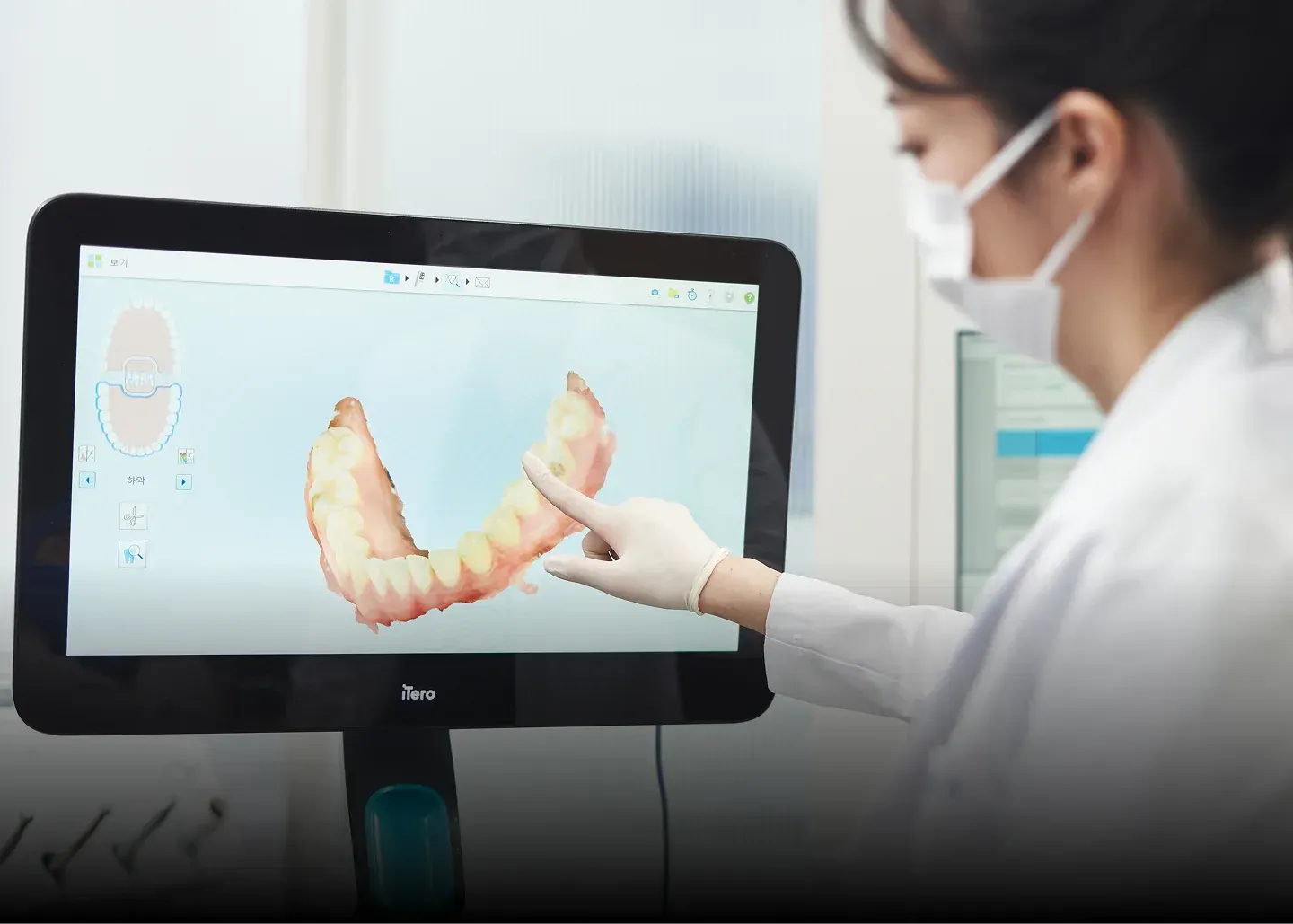
Impacted and high canines at a glance
| Question | In brief |
|---|---|
| What it is | Impacted: an adult canine that fails to erupt or is heading off course. High (ectopic): a canine that erupts above or outside the line of the other teeth |
| Common causes | Lack of space, an unusual eruption path, small or missing upper side teeth, a baby canine that stays too long, inherited tendency |
| Usually noticed | Ages 10–13: the baby canine isn’t loose, the adult canine can’t be felt in the gum, or it appears high up |
| How it’s assessed | Examination and feeling the gum, X-rays or 3D CT to locate the canine and check neighbouring roots, space analysis, growth stage |
| Treatment options | Monitoring; removing the baby canine in selected cases; creating space; surgical exposure with orthodontic guidance; braces to align |
| Typical approach: children | Check by about age 10; early steps can sometimes help the canine find its way in |
| Typical approach: adults | Exposure and orthodontic alignment where feasible; otherwise a planned alternative such as a replacement tooth |
When do canines usually come in?
The lower adult canines usually appear around ages 9 to 10, and the upper canines around ages 11 to 12. Upper canines travel a long path from high in the jaw, and apart from wisdom teeth they are the teeth that most often become impacted. An impacted upper canine may lie towards the roof of the mouth or towards the lip.
Signs worth having checked include a baby canine that is still firm after about age 11, a missing bulge in the gum above the baby canine, one canine arriving much later than the other side, or a canine appearing high up near the gum line. Our guide on when your child should see an orthodontist lists other signs.
What causes impacted or high canines?
- Not enough space: with crowding , the canine is often the last tooth in the front to arrive and gets pushed high or outside the arch. People sometimes call these “snaggle teeth”
- An off-course eruption path: the canine heads towards the palate or the neighbouring roots
- Small or missing upper side teeth, which can leave the canine without guidance
- A retained baby canine that blocks the way
An impacted canine can press on the roots of the neighbouring front teeth and shorten them, often without symptoms. This is one reason early 3D imaging matters.
Does my child need treatment now?
Timing matters more with canines than with most teeth. If a canine is heading off course at around 10 to 12, simple steps can sometimes redirect it: in selected children, removing the baby canine, or creating space with an expander or braces, can improve its path. If the canine is already deeply impacted, or the child is older, these steps are less likely to work. See early orthodontic treatment and keeping and creating space .
How are impacted canines brought into place?
When a canine will not come in by itself, an oral and maxillofacial surgeon can uncover it in a minor procedure and attach a small bracket. Dr. Lee then guides the canine gently into the arch with braces , a process that takes time. High canines that have already erupted are aligned once enough space has been made, sometimes without extractions.
Braces or aligners?
Aligners can move some mildly displaced canines, but canines that need large or vertical movements, or traction after exposure, are usually more predictable with fixed braces. See braces vs clear aligners .
How Dr. Lee assesses canines
A RAY Quantum 5D CT scan shows exactly where the canine lies in three dimensions and whether neighbouring roots are affected, which a flat X-ray can miss. A digital scan measures the space available, and growth analysis helps judge whether early steps are still worthwhile.
Related cases: high canines treated without extractions
- Both upper canines erupted high and outside the arch , with a severe deep bite; braces for 19 months
- One upper and both lower canines outside the arch , with crowding and a deep bite; braces for 18 months
Both were treated without extractions and are published with patient consent. Results vary from person to person.
Impacted canine FAQs
What happens if an impacted canine is left alone?
It may stay buried for life without causing trouble, but it can also damage the roots of neighbouring teeth, and the baby canine will usually be lost eventually, leaving a gap. Because root damage often causes no symptoms, a CT scan is the reliable way to know whether waiting is safe.
Should my child’s baby canine be pulled to help the adult canine?
In some children aged roughly 10 to 13 with a canine heading slightly off course, removing the baby canine can help the adult canine improve its path. It does not work in every case, and depends on the canine’s position, the space available and the child’s age. Dr. Lee decides after reviewing the CT scan.
Is surgery to expose a canine painful?
Exposure is a minor procedure usually done under local anaesthetic by an oral and maxillofacial surgeon. Most patients have some soreness and swelling for a few days afterwards, managed with ordinary pain relief. The surgeon explains the details and any alternatives before the procedure.
Do high canines always mean teeth need to be extracted?
No. High canines are usually a space problem, and space can sometimes be created by widening the arch, moving back teeth or slight enamel reshaping. Both published braces cases with high canines were treated without extractions. Whether that works for your child depends on the amount of crowding.
How long does it take to bring an impacted canine into place?
Guiding an impacted canine is one of the slower movements in orthodontics, because the tooth often has a long way to travel. Overall treatment commonly takes longer than for crowding alone. Dr. Lee gives you an estimated timeline once she has seen the CT scan.
Medically reviewed by Dr. Sally Chaekyung Lee, DDS, PhD
Board-certified orthodontist (Korea Ministry of Health and Welfare) · Adjunct Professor of Orthodontics, Yonsei University · Last updated October 2026
This page is general information, not a diagnosis. Treatment results and duration vary from person to person. Orthodontic treatment can cause temporary discomfort and, in some cases, root shortening, gum recession or tooth decay if oral hygiene is poor; teeth can relapse if retainers are not worn as instructed.
Is your child’s canine coming in late?
Book an examination and Dr. Lee will locate the canine with 3D imaging and explain, in English, whether to act now or monitor. Isu Station Exit 2 · Open until 9 PM Mon & Thu · Saturdays 9 AM–2 PM.