
Guide · Braces & aligners
How Long Does Orthodontic Treatment Take?
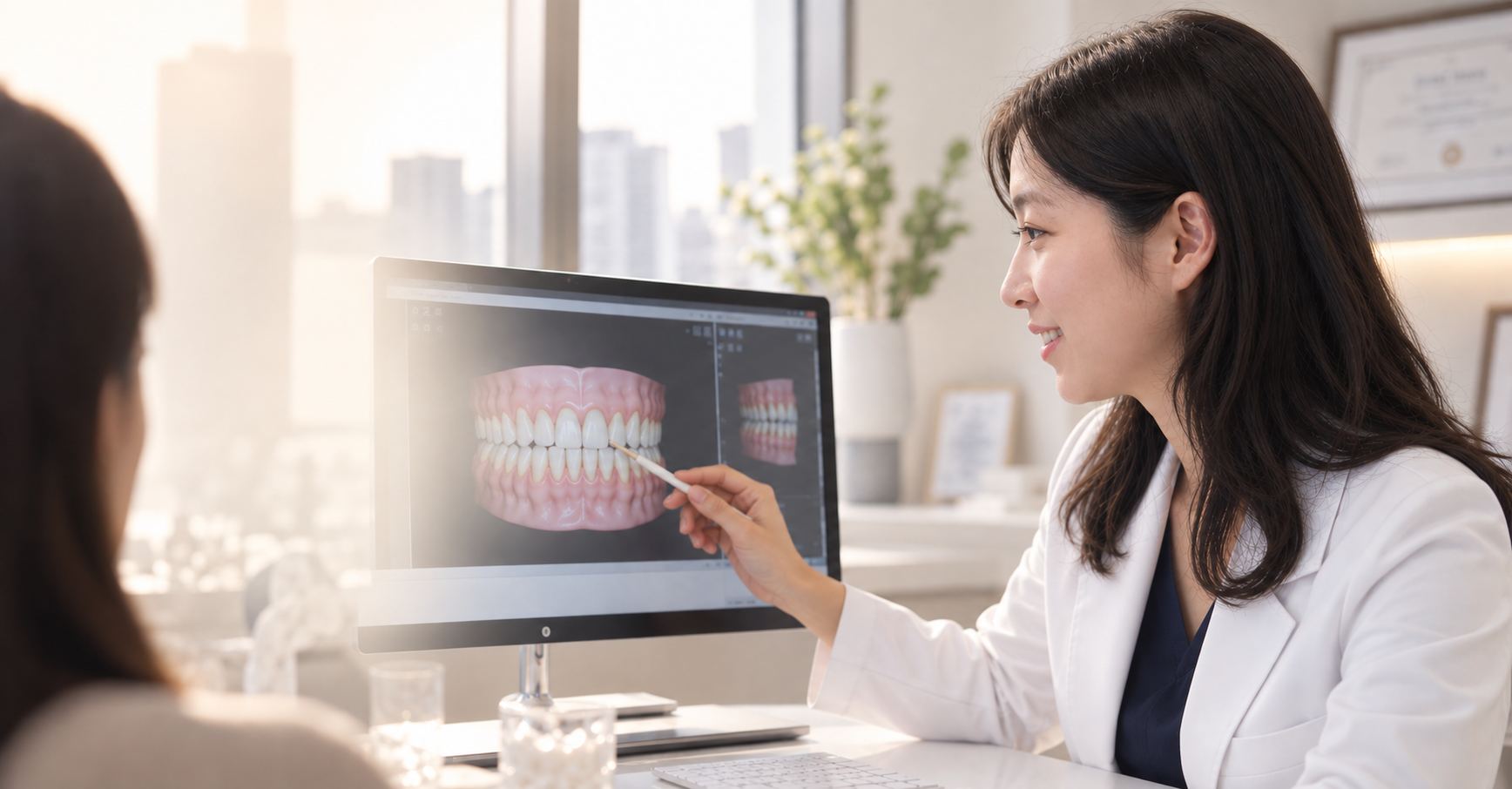
Many comprehensive orthodontic cases take somewhere between one and a few years of active treatment, and limited cases can be shorter. The real answer depends on your bite, age, appliance and daily habits, and retainers follow for the long term. At Yonsei Baro near Isu Station, Dr. Sally Chaekyung Lee gives you a personal timeline after your examination.
Treatment time at a glance
| Question | General answer |
|---|---|
| Comprehensive treatment | Often somewhere between one and a few years of active treatment, depending on the case |
| Limited (front-teeth) treatment | Can be shorter, when it will not harm the overall bite |
| Early treatment for children | A shorter, focused phase, then monitoring as adult teeth come in |
| Check-up intervals | Braces about every 4–6 weeks; aligners about every 6–10 weeks |
| After active treatment | Retainers for every case, worn for the long term as instructed |
| Your own estimate | From Dr. Lee after a full examination, with a written fee estimate |
What decides how long treatment takes?
Two people who start on the same day can finish months apart. That is normal, and it usually comes down to a few factors:
- How far the teeth need to move. Mild crowding or a small gap is quicker to correct than severe crowding or large spaces.
- Whether the bite needs correcting. Changing how the upper and lower teeth meet — a deep bite, underbite or crossbite — usually takes longer than straightening alone.
- Teeth not yet in place. Guiding an impacted or high canine into the arch means moving it gently over a long distance.
- Space decisions. How space is created — expansion, moving back teeth or, in some cases, extractions — changes the sequence.
- Growth. In children and teens, growth can help correct jaw relationships; adults rely on tooth movement alone, or surgery in some skeletal cases.
- Your own biology. Bone remodels around moving teeth at different speeds in different people.
- Daily cooperation. Elastic and aligner wear, kept appointments and few breakages keep a plan on track.
The phases of orthodontic treatment
Every case moves through the same broad stages. You can read the full step-by-step route, from first message to retainers, on our orthodontic treatment process page.
1. Examination and planning
The first orthodontic examination at Yonsei Baro takes about 60 minutes: X-rays or a 3D CT scan, a digital scan, photographs and a clinical exam. Dr. Lee then explains the plan, options, estimated timeline and a written estimate.
2. Active treatment
This is the time you wear braces or aligners: first levelling and aligning, then correcting the bite and spaces, and finally finishing — the small adjustments that help the result look natural and stay stable. Finishing often takes longer than people expect, and it is worth the time.
3. Retention
When braces come off, the bone and gum fibres around the teeth are still settling, and teeth can drift throughout life. That is why retainers are part of every case at Yonsei Baro, worn for the long term as instructed, with retention check-ups after active treatment ends.
Does age change the timeline?
Children (roughly 6 to 10). Early (Phase 1) treatment is usually a shorter, targeted phase — correcting a crossbite or guiding jaw growth, for example — followed by monitoring. Some children need a second phase later; others do not.
Teens. Most adult teeth are in, and remaining growth can still help some bite corrections. Teen orthodontics is often planned around school terms and exams.
Adults. Teeth move at any age if the gums and bone are healthy, though existing crowns or gum recession may shape the plan. See adult orthodontics .
Are clear aligners faster than braces?
Not automatically. Treatment time is set mainly by the problem being corrected, not the appliance. Aligners such as Invisalign work only while worn — usually 20 to 22 hours a day — and short wear time is the most common reason a case falls behind plan. Fixed braces work around the clock but can be slowed by broken brackets. See braces vs clear aligners for a fuller comparison.
For scale, the three cases on our before and after page took 18, 19 and 20 months of active treatment. They are shared with patient consent; every case differs and results vary.
How can you help treatment stay on schedule?
- Wear aligners and elastics exactly as instructed, holidays included.
- Keep your check-ups, about every 4–6 weeks with braces and 6–10 weeks with aligners.
- Avoid hard and sticky foods that break brackets — see what to eat with braces .
- Keep gums healthy, because inflammation can slow tooth movement: brushing and flossing with braces .
- If a bracket comes loose or an aligner is lost, send us a photo by WhatsApp or KakaoTalk; see braces and aligner problems .
Living in Seoul for a fixed term?
Tell us your expected departure date at the first visit. Dr. Lee will tell you honestly what is realistic in that time and, if you leave before the end, prepare full English records so another orthodontist can continue. Read about moving during treatment and short stays in Seoul .
Treatment time FAQs
Can my braces be finished in time for a wedding or graduation?
Possibly, so tell us the date at your first visit. Dr. Lee will explain what is realistic before then and whether the plan can be staged around it. Teeth cannot safely move faster than the bone around them adapts, so she will not promise a date that would compromise the result.
Why might treatment take longer than my first estimate?
The usual reasons are less aligner or elastic wear than prescribed, repeated broken brackets, missed appointments and gum inflammation. Teeth also respond at different speeds in different people. If the timeline changes, Dr. Lee explains why and what happens next.
How long will I need to wear retainers?
For the long term. Teeth can shift throughout life, so retention does not have a fixed end date. The schedule usually becomes less demanding once the teeth have settled, but your orthodontist sets it for you. Our retainers page explains fixed and removable options.
Is treating only the front teeth always quicker?
Limited treatment is usually shorter, but it suits only some cases. Dr. Lee recommends it only after confirming that moving the front teeth will not harm the overall bite. If the back teeth also need correcting, a shorter plan may simply not deliver a stable result.
Medically reviewed by Dr. Sally Chaekyung Lee, DDS, PhD
Board-certified orthodontist (Korea Ministry of Health and Welfare) · Adjunct Professor of Orthodontics, Yonsei University · Last updated October 2026
This page is general information, not a diagnosis. Treatment results and duration vary from person to person. Orthodontic treatment can cause temporary discomfort and, in some cases, root shortening, gum recession or tooth decay if oral hygiene is poor; teeth can relapse if retainers are not worn as instructed.
Find out how long your treatment would take
Send us your concern and any dates that matter to you. Dr. Lee will examine you herself and explain a realistic timeline in English. Isu Station Exit 2 · Open until 9 PM Mon & Thu · Saturdays 9 AM–2 PM.