
Home › Orthodontics › Growth Guidance
Kids’ orthodontics · Growing children
Growth Guidance: Using a Child’s Growth to Improve the Bite
Growth guidance, also called growth modification, uses orthodontic appliances while a child is growing to improve how the upper and lower jaws fit together. At Yonsei Baro, near Isu Station in Seoul, Dr. Sally Chaekyung Lee times it with a skeletal-maturity analysis and, when useful, 3D CT, and explains every step in English.
Growth guidance at a glance
| Question | At Yonsei Baro |
|---|---|
| What it can help | Narrow upper jaw, lower jaw set back, developing underbite, some jaw shifts |
| When | Set by skeletal maturity and stage of growth, not by birthday |
| How timing is checked | X-ray-based growth-plate and skeletal-maturity analysis, plus RAY Quantum 5D 3D CT when useful |
| Appliances | Chosen for each child, for example expanders or functional appliances |
| Limits | Response to growth varies; braces or other treatment may still be needed later |
| Treated by | Dr. Sally Chaekyung Lee, board-certified orthodontist |
What is growth modification?
Most orthodontic treatment moves teeth. Growth modification aims at the jaws themselves: while bones are still growing, an appliance can encourage or redirect growth, or widen a narrow upper jaw before the bones fully mature. Once growth slows, the same change usually needs different treatment, such as tooth movement to compensate or, in some adults, jaw surgery.
It is one of the four approaches we use in children’s orthodontics , often as part of early (phase 1) treatment .
Why does timing depend on skeletal maturity rather than age?
Two children of the same age can be at very different stages of growth, and girls generally mature earlier than boys. Effective growth guidance depends on where a child is on their own growth curve.
As a general pattern, treatment aimed at widening or bringing forward the upper jaw tends to respond better at younger ages, while appliances that rely on lower-jaw growth are often timed closer to the pubertal growth spurt. Start too early and treatment may run longer than needed; start too late and the opportunity to use growth may have passed.
How we assess your child’s growth
Skeletal-maturity analysis
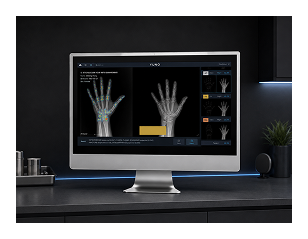
An X-ray-based growth-plate and skeletal-maturity analysis program helps estimate your child’s stage of growth and how much remains, so treatment can be timed rather than guessed.
3D cone-beam CT
Our RAY Quantum 5D CT shows the teeth, jawbones and jaw joints in three dimensions, including adult teeth that have not yet come in. Dr. Lee requests a scan when it adds information that affects the plan.
Digital scans and face scanning
An intraoral scanner records the teeth without impression putty, and the RAY Face 3D face scanner captures facial form. Combined, they let Dr. Lee compare changes over time. Read more about our technology .
Which problems can growth guidance help?
A narrow upper jaw or crossbite
An expander can widen the upper jaw while it is still growing, often correcting a crossbite and creating space for crowded teeth.
A lower jaw that sits back
When upper front teeth stick out because the lower jaw is set back, a functional appliance can encourage a better front-to-back relationship during growth.
A developing underbite
Some underbites involve an upper jaw that is underdeveloped. Early treatment can improve the relationship, although growth in the teenage years needs monitoring.
A jaw that shifts to one side
A narrow upper jaw can make the lower jaw slide sideways to bite together. Correcting it early can help prevent jaw asymmetry from becoming established.
What growth guidance can and cannot do
Children respond to growth guidance differently, and genetics strongly influence how the jaws grow. Some children still need braces or aligners later, and a small number of growth patterns, particularly strong lower-jaw growth, may eventually call for surgical treatment after growth has finished.
Dr. Lee’s research has included the stability of surgical-orthodontic treatment, and she is a member of the Korean Academy of Growth Dentistry. She will tell you honestly when growth guidance is worth trying, and when a different plan is more realistic.
Growth guidance FAQs
How can you tell whether my child is still growing?
Height changes and age give clues, but they are not precise. Dr. Lee uses an X-ray-based skeletal-maturity analysis to estimate your child’s stage of growth and how much is likely to remain, then reviews it alongside the bite and 3D records. Growth is re-checked during treatment, because timing matters.
Is a 3D CT scan safe for children?
Dental cone-beam CT generally uses a much lower radiation dose than a medical CT scan, and it is requested only when the information will help with a treatment decision, for example to locate adult teeth that have not erupted. Dr. Lee will explain why a scan is recommended before it is taken.
Is wearing an expander uncomfortable?
Most children feel pressure on the teeth and the roof of the mouth for a few days after each adjustment, and speech or eating can feel different at first. A temporary gap often appears between the upper front teeth as the jaw widens; this is expected. We give you clear instructions, in English, for any adjustments at home.
What if my child has already passed the growth spurt?
Options still exist. Many bite problems can be improved with braces or aligners, sometimes with skeletal anchorage to support tooth movement. For significant jaw differences in adults, orthodontics combined with jaw surgery may be discussed. Dr. Lee will explain which options fit your teenager’s stage of growth.
Will growth guidance change my child’s face?
The goal is a healthier jaw relationship and bite. Some children show visible changes in profile, but the amount varies and cannot be predicted precisely. Dr. Lee records facial form with a 3D face scan so changes can be compared over time, and will discuss realistic expectations with you.
Medically reviewed by Dr. Sally Chaekyung Lee, DDS, PhD
Board-certified orthodontist (Korea Ministry of Health and Welfare) · Adjunct Professor of Orthodontics, Yonsei University · Last updated October 2026
This page is general information, not a diagnosis. Treatment results and duration vary from person to person. Orthodontic treatment can cause temporary discomfort and, in some cases, root shortening, gum recession or tooth decay if oral hygiene is poor; teeth can relapse if retainers are not worn as instructed.
Find out if growth guidance suits your child
Book a check with Dr. Lee. She will assess your child’s growth and explain the options in English. Isu Station Exit 2 · Open until 9 PM Mon & Thu · Saturdays 9 AM–2 PM.