
Home › Orthodontics › Before Implants & Crowns
Orthodontics · Adults
Orthodontics Before Implants and Crowns: Preparing the Space
Sometimes teeth need to be moved before an implant, crown or bridge can be placed well. Pre-prosthetic orthodontics uprights tipped teeth, redistributes uneven spaces and aligns roots so the restoration fits properly. At Yonsei Baro near Isu Station, Seoul, Dr. Sally Chaekyung Lee plans this with your restorative dentist and explains it in English.
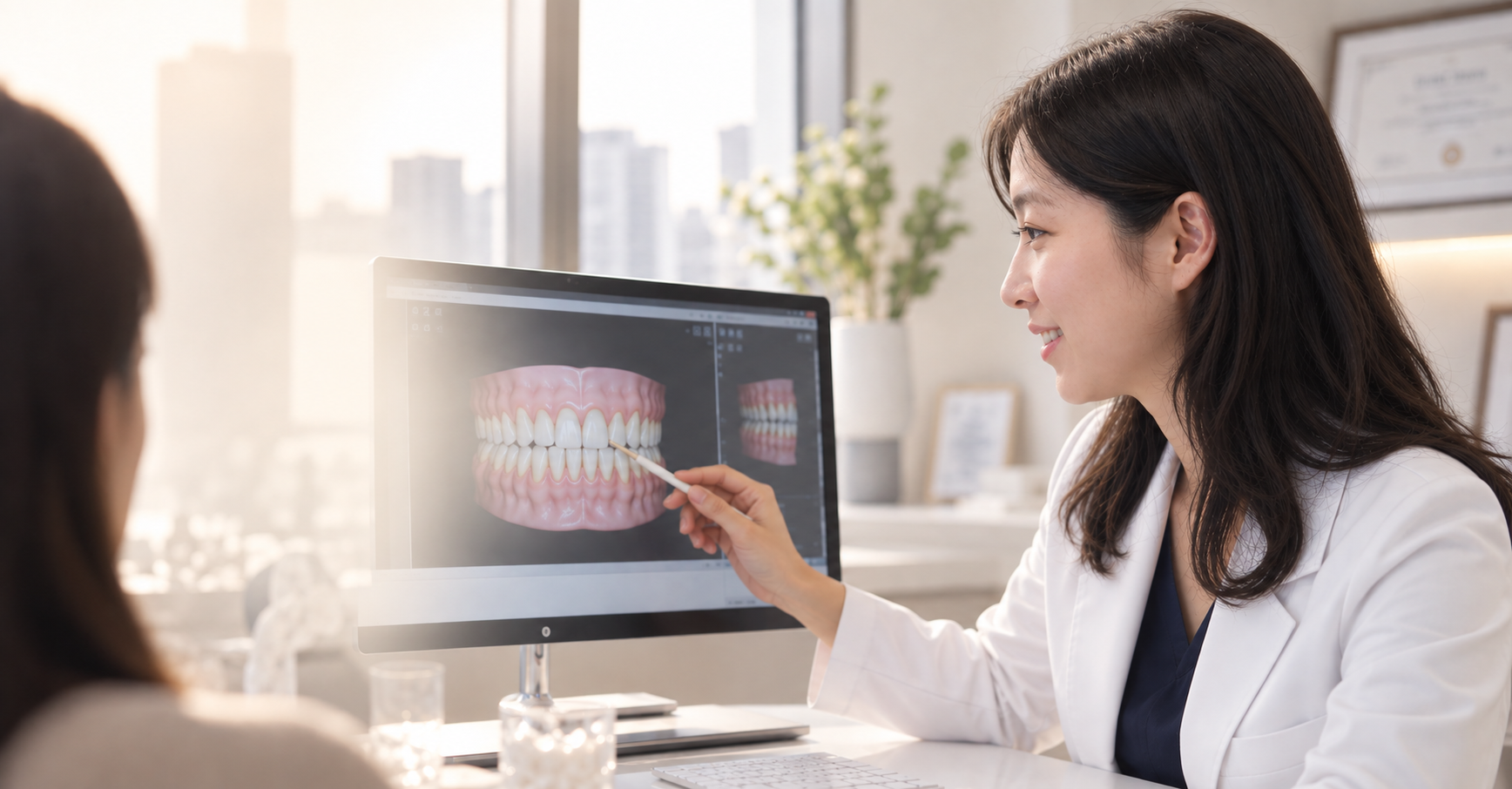
Pre-prosthetic orthodontics at a glance
| Question | At Yonsei Baro |
|---|---|
| What it is | Short, targeted orthodontic treatment to prepare teeth and spaces before an implant, crown, bridge or veneers |
| Common goals | Uprighting tipped teeth, redistributing uneven gaps, aligning roots, creating room for a restoration, improving the bite |
| Appliances | Fixed braces on some teeth, clear aligners, or a combination |
| Planning | X-rays or 3D CT, intraoral scan and photographs; coordinated with your implant or restorative dentist |
| Who places the implant or crown | Your own dentist or a specialist; Dr. Lee prepares the teeth and space |
| Treated by | Dr. Sally Chaekyung Lee, board-certified orthodontist, in English |
| Cost | Written estimate after a full examination |
Why might teeth need to move before an implant or crown?
When a tooth has been missing for a while, the teeth on either side tend to tip into the gap, and the opposite tooth can drift into the space. Over time, that leaves a gap that is too narrow, too wide or the wrong shape for a good replacement.
Moving the teeth first can make the final restoration stronger, easier to clean and more natural-looking. It can also mean less healthy tooth structure needs to be removed, for example when preparing teeth for a bridge or veneers.
What can orthodontics do before restorative work?
Uprighting tipped teeth
A molar that has leaned into a gap makes it hard to place an implant or bridge in the right direction. Uprighting it restores a more vertical position, opens the space and helps the bite share chewing forces properly.
Redistributing space
If spaces are uneven, orthodontics can gather them where they are needed. This can mean one well-sized implant or restoration rather than two compromised ones, or closing small gaps between teeth altogether.
Aligning roots for implants
An implant needs enough room between neighbouring roots. Using a 3D CT scan, Dr. Lee checks the angle of the roots beside the gap and can move them apart so the implant can be placed safely.
Creating vertical room
When an opposing tooth has over-erupted into a gap, there may not be enough height for a crown. Orthodontic intrusion can help restore room without heavy reshaping of the opposing tooth.
Preparing for veneers or crowns on front teeth
Aligning crowded or rotated front teeth first can mean that veneers need less preparation, or that crowns sit in a more natural position.
How is pre-prosthetic orthodontics planned?
Dr. Lee prepares the teeth and spaces; your dentist or implant surgeon places the final restoration. Planning usually follows these steps (see also our treatment process ):
- Examination and records (about 60 minutes). X-rays and, when useful, a 3D CT scan; an intraoral digital scan, photographs and a full check of teeth, gums, roots and bite.
- Agreeing the target. Dr. Lee discusses the ideal space, root position and bite with your restorative dentist so the orthodontic goal matches the restoration they plan. If your dentist is outside Korea, she can provide records and notes in English.
- Focused treatment. Often limited to the teeth involved, using fixed braces, aligners or both. Because only some teeth move, this is usually shorter than full treatment, but Dr. Lee gives you an estimated timeline for your case.
- Holding the space. Once the teeth are in position, a retainer or temporary tooth keeps the space stable until the implant, crown or bridge is placed.
Gum health is checked before and during treatment, and any gum problems need to be stable before teeth are moved. If you already have implants, they cannot be moved, so the plan is built around them.
Is this right for me?
It may help if you have a long-standing gap, a tipped tooth next to a space, uneven gaps, or a dentist who has suggested moving teeth before restorative work. In some cases the right plan is a fuller course of adult orthodontics , and in others a short, limited treatment is enough. Dr. Lee will explain which applies to you, and if orthodontics would not improve the outcome, she will tell you that too.
Before implants & crowns FAQs
Do I need braces before getting a dental implant?
Not always. If the gap is the right size and the neighbouring roots are well positioned, an implant can often be placed without orthodontics. Orthodontics helps when teeth have tipped into the space, the gap is too narrow or wide, or the opposing tooth has drifted. Dr. Lee and your implant dentist can assess this together.
Can a tilted molar be straightened before a bridge or implant?
Yes. Uprighting a molar that has tipped into a gap is a common pre-prosthetic movement. It opens the space, improves the direction of chewing forces and can reduce how much the tooth needs to be shaped for a bridge. A 3D CT scan helps Dr. Lee plan how far the tooth can safely move.
How long does orthodontic preparation before an implant take?
It depends on how far the teeth need to move. Focused treatment involving a few teeth is often shorter than full orthodontic treatment, but uprighting molars or moving roots apart still takes time for bone to remodel. Dr. Lee gives you an estimated timeline after your examination and can coordinate with your dentist’s schedule.
Will the space stay open while I wait for my implant?
Yes, if it is held. Once the teeth are in position, Dr. Lee fits a retainer, sometimes with a temporary tooth in the gap, to keep the space stable until the implant or crown is placed. It is important to wear it as instructed, because teeth can start to drift back within weeks.
Can you work with my dentist abroad?
Yes. If your implant or crown will be placed by a dentist in another country, Dr. Lee can provide English records, digital 3D scans in standard formats, X-rays and treatment notes, and contact your dentist directly when needed. Tell us your plans at your first visit so timing can be coordinated.
Medically reviewed by Dr. Sally Chaekyung Lee, DDS, PhD
Board-certified orthodontist (Korea Ministry of Health and Welfare) · Adjunct Professor of Orthodontics, Yonsei University · Last updated October 2026
This page is general information, not a diagnosis. Treatment results and duration vary from person to person. Orthodontic treatment can cause temporary discomfort and, in some cases, root shortening, gum recession or tooth decay if oral hygiene is poor; teeth can relapse if retainers are not worn as instructed.
Planning an implant or crown?
Ask whether moving a few teeth first would help. Dr. Lee will examine you herself and explain your options in English. Isu Station Exit 2 · Open until 9 PM Mon & Thu · Saturdays 9 AM–2 PM.