
Home › Before & After › Invisalign: Crowded Front Teeth
Case study · Adult · Invisalign
Invisalign Before and After: Crowded Front Teeth in an Adult
This adult came to Yonsei Baro near Isu Station, Seoul, with crowded, overlapping front teeth and one upper front tooth that stuck out. Dr. Sally Chaekyung Lee treated the case with Invisalign clear aligners, without removing any teeth, over 20 months of active treatment from July 2024 to March 2026.
Case at a glance
| Detail | This case |
|---|---|
| Age group | Adult |
| Main concern | Crowded, overlapping front teeth; one upper front tooth stuck out |
| Appliance | Invisalign clear aligners |
| Extraction | None (non-extraction treatment) |
| Active treatment | 20 months (July 2024 – March 2026) |
| Treated by | Dr. Sally Chaekyung Lee, board-certified orthodontist |
| After treatment | Retainers, with retention check-ups at the clinic |
What was the patient’s concern?
The patient’s front teeth were crowded and overlapped one another, and one upper front tooth stuck out of line with its neighbours. Crowding like this is common in adults. It can be present from adolescence or develop gradually, and it is a common reason adults seek orthodontic treatment .
Beyond appearance, overlapping teeth create tight corners where plaque collects and a toothbrush or floss struggles to reach. A tooth that stands out of line can also be more exposed to chipping and uneven wear.
How was the case diagnosed?
Every orthodontic case at Yonsei Baro starts with an examination of about 60 minutes: an intraoral digital scan, photographs, and X-rays or a 3D cone-beam CT scan, followed by a clinical examination by Dr. Lee. A CT shows the roots and the bone around them, which matters when deciding how far teeth can safely move.
The key question in a crowded case is how to make room. Dr. Lee assesses how much space is missing, the thickness of bone around the front teeth and the balance of the lips and profile. In this case, the conclusion was that the teeth could be aligned without extractions. You can read more about this decision on our crowded teeth page.
What was the treatment plan?
Dr. Lee planned the case with Invisalign , using ClinCheck® software to map the tooth movements stage by stage before any aligners were made. Dr. Lee is a 2026 Invisalign® Purple Diamond Provider; provider tiers reflect the number of Invisalign cases a doctor has treated, not a guarantee of results.
In non-extraction aligner treatment, space is usually gained through a combination of approaches, such as gently developing the arch form, slightly reshaping the contacts between teeth, or adjusting the angle of the front teeth. Which of these is appropriate, and how much of each, depends on the individual examination. We publish the main facts of each case; detailed clinical records stay private.
Before and after photographs
The photographs below compare the front teeth before treatment and at the end of active treatment. They show the same patient, published with consent.
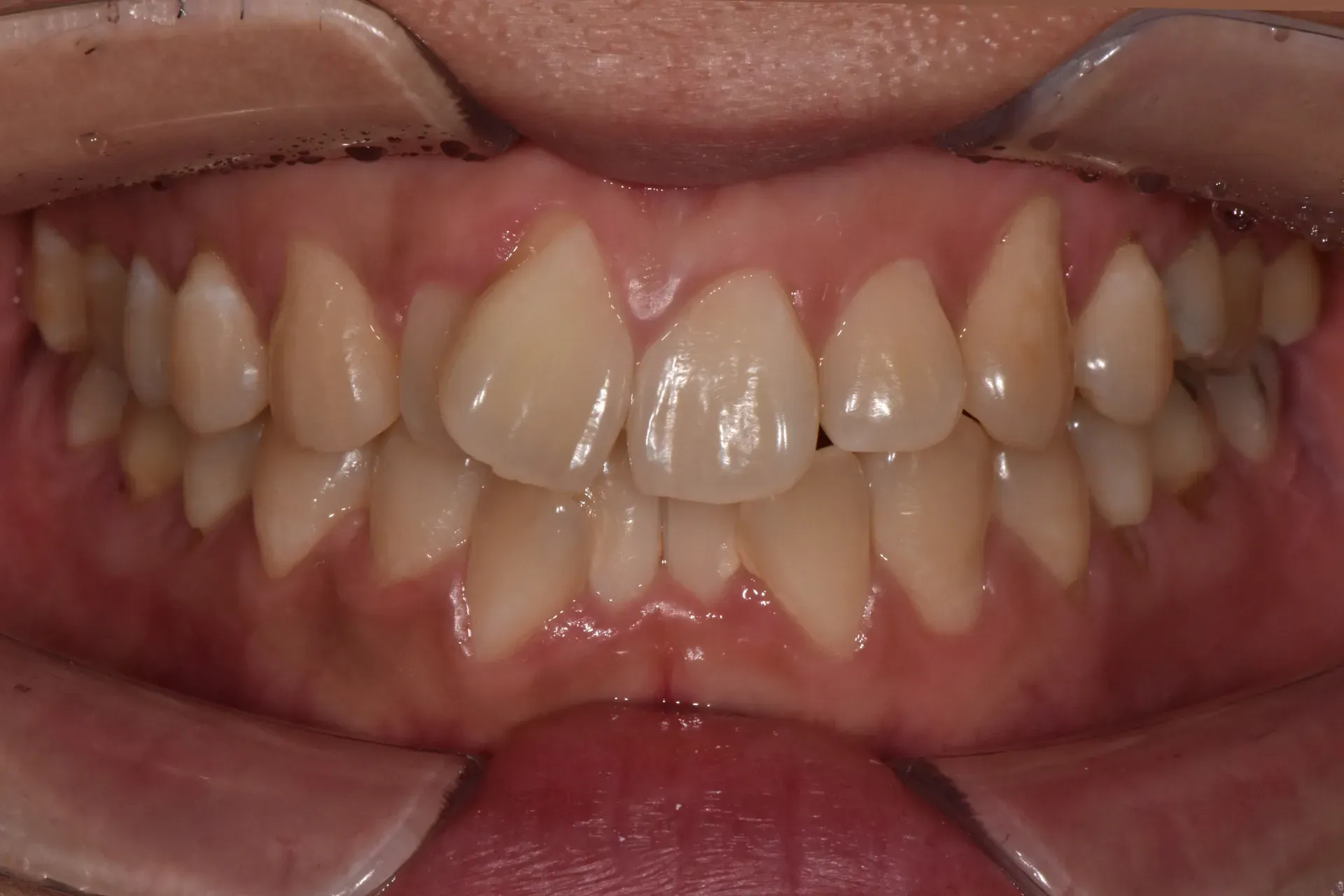
Before treatment. Crowded, overlapping front teeth, with one upper front tooth sticking out of line.
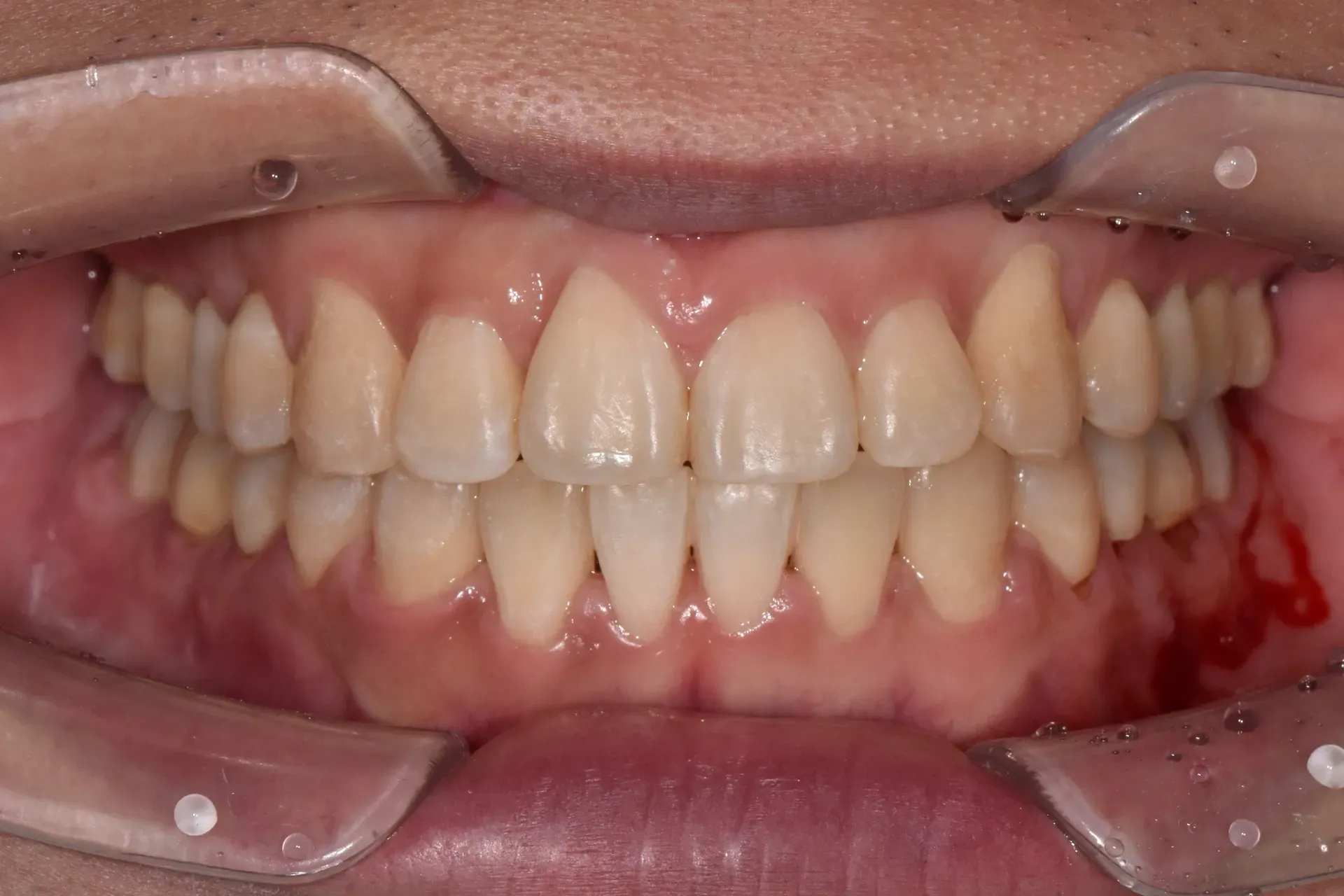
After active treatment. The front teeth at the end of 20 months of Invisalign treatment, with no extractions.
Results vary — please read
This case is published with the patient’s consent. It shows one person’s result and is not a prediction or promise of yours: treatment time and outcome depend on your teeth, bone, growth, gums and habits, and, with aligners, on daily wear. Orthodontic treatment can cause temporary discomfort and, in some cases, root shortening (root resorption), tooth decay or gum problems if teeth are not kept clean, and relapse if retainers are not worn as instructed.
What changed during treatment?
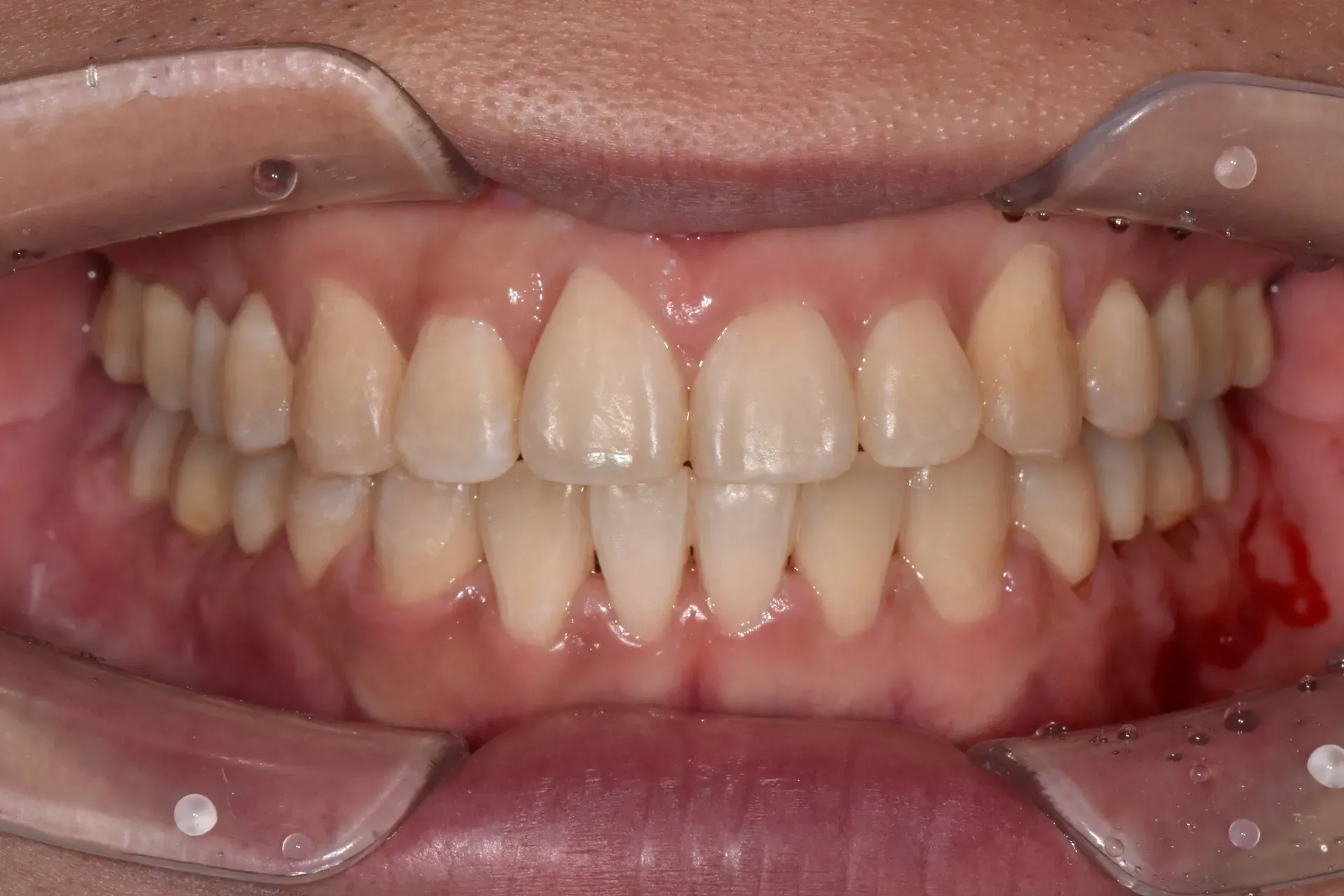
The aim of treatment was to bring the crowded front teeth into line and return the upper front tooth that stuck out to the arch, without removing any teeth. The after photograph shows the front teeth at the end of 20 months of active treatment. Teeth in line are also generally easier to clean, because there are fewer overlapping corners where plaque can collect.
Twenty months is the length of this patient’s active treatment, not a standard. Aligner cases can finish sooner or take longer depending on how much movement is needed, how the teeth respond and how consistently the aligners are worn. Our guide to how long orthodontic treatment takes explains the main factors.
How does retention keep the result stable?
Teeth that were once crowded have a natural tendency to drift back, especially in the first months after treatment and gradually over the years. That is why every case at Yonsei Baro finishes with retainers .
Retainers can be fixed (a thin wire bonded behind the front teeth) or removable (a clear tray worn as instructed), and some people use both. Dr. Lee chooses the type and wear schedule for each case and continues to see patients for retention check-ups. If a patient moves abroad, we provide retainer records so a new orthodontist can continue care.
Questions about this case
How long did this adult Invisalign case take?
Active treatment took 20 months, from July 2024 to March 2026. That period covers the aligner phase, from the first set to the end of active tooth movement. Retention began afterwards. Your own timeline will depend on how much your teeth need to move, and Dr. Lee gives you an estimate after your examination.
Were any teeth removed to make room?
No. After examining the amount of crowding, the bone around the front teeth and the facial profile, Dr. Lee concluded that the teeth could be aligned without extractions. That decision is made individually. In some people with severe crowding or very full lips, removing teeth leads to a more stable or balanced result.
Can Invisalign fix a single tooth that sticks out?
Often, yes, but the tooth is usually treated as part of the whole arch. Moving one tooth back into line needs space, which affects the neighbouring teeth and the bite. Dr. Lee checks whether a limited approach would keep the overall bite healthy; if not, she will explain why a fuller plan is needed.
Is crowding in adults harder to treat than in teenagers?
Not necessarily harder, but different. Adults are no longer growing, so space is created by moving teeth rather than by guiding jaw growth. Gum and bone health need closer attention, and some adults have crowns or missing teeth to plan around. Healthy adult teeth can be moved at any age.
Will my crowded teeth come back after Invisalign?
They can if retainers are not worn as instructed. Teeth tend to drift back toward their old positions, especially after crowding. Wearing your retainers as prescribed and attending retention check-ups is the most reliable way to keep the alignment you achieved.
Medically reviewed by Dr. Sally Chaekyung Lee, DDS, PhD
Board-certified orthodontist (Korea Ministry of Health and Welfare) · Adjunct Professor of Orthodontics, Yonsei University · Last updated October 2026
This page is general information, not a diagnosis. Treatment results and duration vary from person to person. Orthodontic treatment can cause temporary discomfort and, in some cases, root shortening, gum recession or tooth decay if oral hygiene is poor; teeth can relapse if retainers are not worn as instructed.
Have crowded front teeth?
Book a consultation and Dr. Lee will examine your teeth and explain whether clear aligners suit your case. Isu Station Exit 2 · Open until 9 PM Mon & Thu · Saturdays 9 AM–2 PM.