
Home › Orthodontics › Braces › Metal Braces
Fixed braces · Children, teens & adults
Metal Braces in Seoul: Precise Control for Complex Tooth Movements
Metal braces use small stainless-steel brackets and a wire to move teeth with precise, continuous control. They are durable, work around the clock and suit children, teens and adults, including people with complex bites. At Yonsei Baro, by Isu Station in Seoul, Dr. Sally Chaekyung Lee plans and adjusts every case herself, in English.
Metal braces at a glance
| Question | At Yonsei Baro |
|---|---|
| Brackets | Stainless steel, bonded to the front surface of each tooth |
| Well suited to | Complex movements, deep bites, high or impacted canines, extraction cases, children and teens |
| Visibility | Visible when you smile; modern brackets are smaller and smoother than many people expect |
| Check-ups | About every 4–6 weeks |
| Treated by | Dr. Sally Chaekyung Lee, board-certified orthodontist, from first consultation to removal of the braces |
| Cost | Written estimate after a full examination |
What are metal braces?
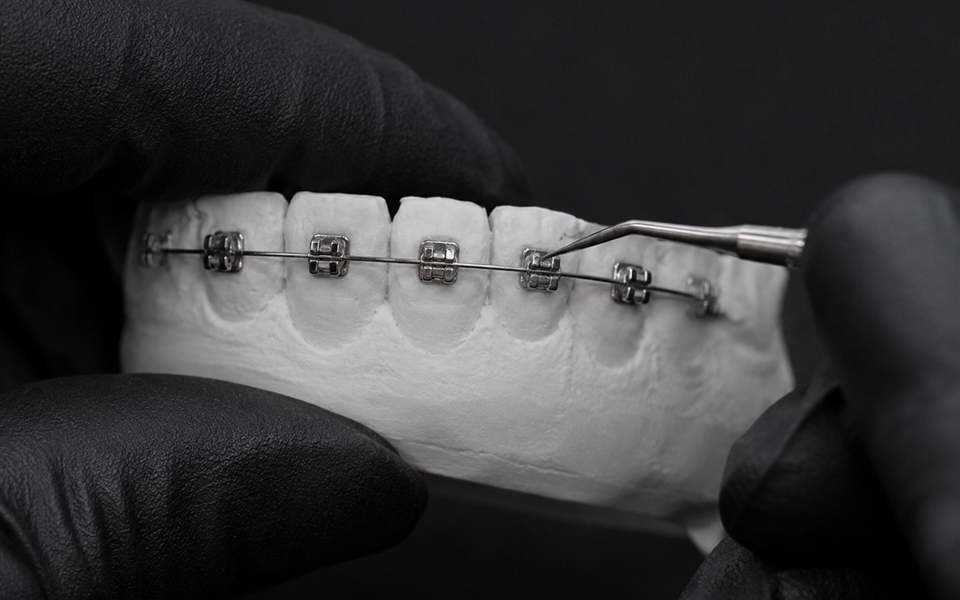
Metal braces are the classic fixed orthodontic appliance. A small stainless-steel bracket is bonded to the front of each tooth, and a thin archwire, held in the bracket slots by elastic ties or a built-in clip, guides each tooth along a controlled path.
Wires progress from thin, flexible ones that start the alignment to stiffer ones that fine-tune root position and the bite. Elastics between the upper and lower teeth can help correct how the jaws meet.
Why might Dr. Lee recommend metal braces?
Precise control of every tooth
A bracket gives the orthodontist a fixed handle on each tooth, so Dr. Lee can control tipping, rotation, height and root angle at the same time. That matters when a tooth needs to travel a long way, turn significantly or be guided into the arch from a high position.
Strong and dependable
Stainless steel is less likely to chip than ceramic and gentler on the opposing teeth in a deep bite. For active children and teenagers, that means fewer breakages and unplanned visits.
Working all day and night
Unlike aligners, braces cannot be left on the bedside table, which makes them practical for younger patients and anyone who has struggled with wear time before.
Who are metal braces suitable for?
Metal braces can treat almost any type of tooth or bite problem. They are especially useful for:
- Children and teens with crowding or canines erupting outside the arch, as in our published case of high canines treated without extractions (shared with patient consent; results vary)
- Deep bites, crossbites and open bites that need precise vertical or sideways control
- Extraction cases where spaces need to be closed in a controlled way
- Adults who put control and efficiency ahead of appearance
For children, timing matters as much as the appliance. Dr. Lee, formerly director of pediatric and adolescent orthodontics at CDC Children’s Dental Clinic, considers growth and the remaining baby teeth before recommending when to start; see orthodontics for children .
What to expect with metal braces at Yonsei Baro
- Examination and records (about 60 minutes). We take an intraoral digital scan (no impression putty), photographs, and X-rays or a 3D CT scan; Dr. Lee then examines your teeth, bite, roots and face.
- Your plan in English. She explains the movements needed, the expected timeline and a written estimate.
- Bonding visit. Teeth are cleaned, brackets are placed one by one and the first wire is fitted. No drilling or injections are involved.
- Adjustments about every 4–6 weeks. Wires are changed and progress is checked. Evening appointments until 9 PM on Mondays and Thursdays, and Saturday mornings, make this easier around school and work.
- Removal and retainers. Dr. Lee removes the braces herself and fits retainers to hold your result .
How do I look after metal braces?
- Brush after meals, angling the brush toward the gum line and around each bracket, and use interdental brushes between teeth. See brushing and flossing with braces .
- Avoid hard and sticky foods that can loosen brackets: ice, nuts, hard sweets, chewy rice cakes (tteok) and meat gnawed straight off the bone. Our guide to eating with braces has practical swaps.
- Wear a mouthguard for contact sports.
- If a bracket comes loose or a wire pokes, cover it with orthodontic wax and send us a photo by WhatsApp or KakaoTalk. We will advise you and arrange a visit.
Metal braces FAQs
Why might Dr. Lee suggest metal rather than ceramic braces?
Metal brackets are smaller and stronger than ceramic ones, so they are less likely to chip or to wear the opposing teeth in a deep bite. For complex movements and younger children, metal is often the practical choice. If appearance matters a great deal to you, Dr. Lee will explain whether ceramic or lingual braces could achieve the same plan.
Can young children have metal braces?
Yes. Many children and teenagers are treated with metal braces because they are strong and work without needing to be taken in and out. Timing still matters: some children benefit from treatment while baby teeth are present, while others are better monitored until more adult teeth arrive. Dr. Lee assesses growth and dental development before recommending when to start.
Do I need to tell other doctors that I wear metal braces?
Yes, it is a good idea. If you need an MRI scan of the head or neck, tell the radiology team, because metal brackets can affect image quality in that area. We can provide a doctor’s letter in English describing your appliance if you need one.
Can metal braces leave marks on my teeth?
The brackets themselves do not stain teeth. The risk comes from plaque trapped around them, which can cause white spots (early decay) or swollen gums if cleaning is poor. Careful brushing after meals, interdental brushes and regular dental check-ups go a long way to preventing this. The small elastic ties can pick up colour from food, but they are replaced at each adjustment.
What happens on the day metal braces come off?
Dr. Lee removes each bracket with a small instrument, polishes away the remaining adhesive and checks your final bite. Your retainers are then fitted to hold the result, and you continue to visit for retainer check-ups. Teeth can feel a little sensitive for a day or so, and the smooth feeling of your teeth without brackets usually takes some getting used to.
Medically reviewed by Dr. Sally Chaekyung Lee, DDS, PhD
Board-certified orthodontist (Korea Ministry of Health and Welfare) · Adjunct Professor of Orthodontics, Yonsei University · Last updated October 2026
This page is general information, not a diagnosis. Treatment results and duration vary from person to person. Orthodontic treatment can cause temporary discomfort and, in some cases, root shortening, gum recession or tooth decay if oral hygiene is poor; teeth can relapse if retainers are not worn as instructed.
Talk to Dr. Lee about metal braces
Send us your concern and preferred dates. Dr. Lee will examine you or your child herself and explain every option in English. Isu Station Exit 2 · Open until 9 PM Mon & Thu · Saturdays 9 AM–2 PM.